3DGEER: 3D Gaussian Rendering
Made Exact and Efficient for Generic Cameras
ICLR 2026
- Bosch Research North America & Bosch Center for AI (BCAI)
Overview
3D Gaussian Splatting (3DGS) has rapidly become one of the most influential paradigms in neural rendering. It delivers impressive real-time performance while maintaining high visual fidelity, making it a strong alternative to NeRF-style volumetric methods. But there is a fundamental problem hiding beneath its success:
Splatting doesn't obey exactness in projective geometry.
The splatting approximation is usually harmless for narrow field-of-view (FoV) pinhole cameras. However, once we move to fisheye, omnidirectional, or generic camera models — especially those common in robotics and autonomous driving — the approximation error becomes significant.
Can Gaussian rendering be both exact and fast without relying on lossy splatting? 3DGEER (3D Gaussian Exact and Efficient Rendering) answers this question with a resounding "Yes" by introducing:
- Projective exactness + Real-time efficiency
- Compatibility with generic camera models (pinhole / fisheye) + Strong generalization to extreme FoV
- Adaptation to widely-used GS frameworks including
diff-gaussian-rasterization,gsplat,drivestudio
Paper Fast Forward
Visual Comparison (check more results.)
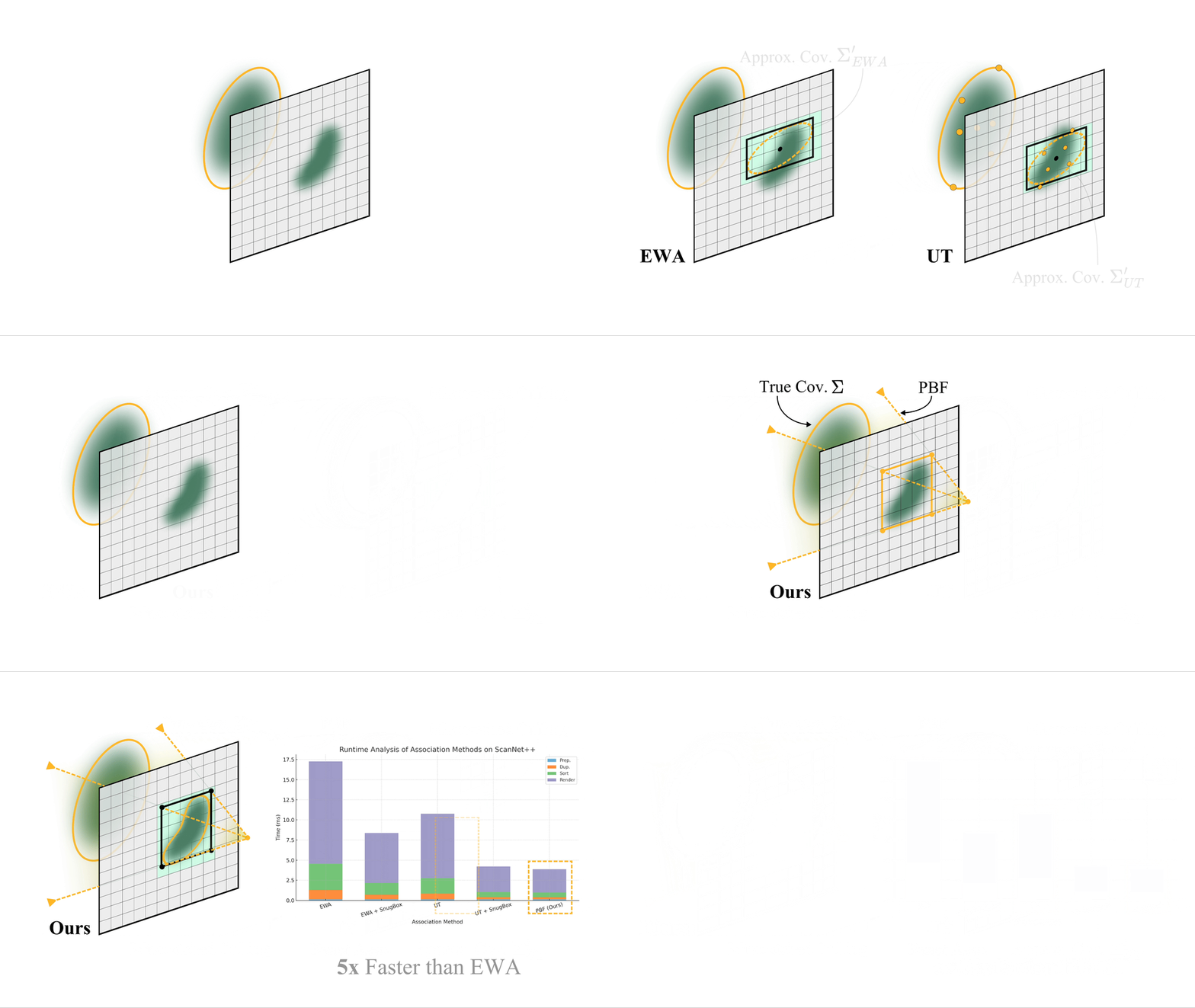
3DGEER outperforms both 3DGS-based (Gaussian Splatting) and 3DPRT-based (Particle Ray Tracing) approaches on novel view synthesis benchmarks — including MipNeRF360 (pinhole), ScanNet++ (fisheye) and ZipNeRF (mix). 3DGEER achieves high rendering fidelity while remaining runtime-efficient — 5× faster than 3DPRT (e.g., EVER, 3DGRT) and comparable to 3DGS, with no sacrifice in exactness.
Out-Of-Distribution (OOD) + Extreme-Wide FoV Views
Side-by-Side Comparison on Close-Up Parking Data: 3DGEER's PBF association (Right) has less popping issues and grid-line-error artifacts compared w/ UT (Left) association.
|
3DGUT |
Ours (3DGEER) |
MipNeRF360 (Pinhole)
3DGS (PSNR: 27.21; FPS: 343) v.s. 3DGRT (PSNR: 27.20; FPS: 52) v.s. 3DGEER (Ours) (PSNR: 27.76; FPS:327)


|

|

|
ScanNet++ (Fisheye)
FisheyeGS (PSNR:27.81; FPS:213) v.s. EVER (PSNR: 29.47; FPS: 13) v.s. 3DGEER (Ours) (PSNR: 31.50; FPS: 251)


|

|

|
ZipNeRF Close-Up Views (click to zoom-in.)
Our method (3DGEER) can handle soft shadow / lights or close views where the solid ellipsoid-based model (EVER) suffers.
|
EVER |
Ours |
EVER |
Ours |
ZipNeRF Large FoV Views (click to zoom-in.)
3DGUT and FisheyeGS are based on equidistant model for representations, which fail in much wider FoV. (See paper Fig. 5). Our method (3DGEER) can effectively sample rays in larger FoV regions and show much better results.
|
3DGUT |
Ours |
FisheyeGS |
Ours |
⚠️ HD video loading time may vary based on your internet speed and available browser memory.
More HD Visual Result (click to zoom-in.)
High-Quality Large FoV Results
Highly Distorted & Close-Up Views
Cross-Camera Rendering (train: FE 1/8; test: PH 1/4)
⚠️ HD video loading time may vary based on your internet speed and available browser memory.
Dynamic Wide-FoV Scene Rendering (with the gsplat-geer integration into drivestudio)
3DGEER can render dynamic scenes with large FoV, where the exact ray-Gaussian integral and association are crucial for handling the extreme distortion.
Key Takeaways: Fixing the Math Behind Gaussian Rendering
See paper Appendix C,D for the math.
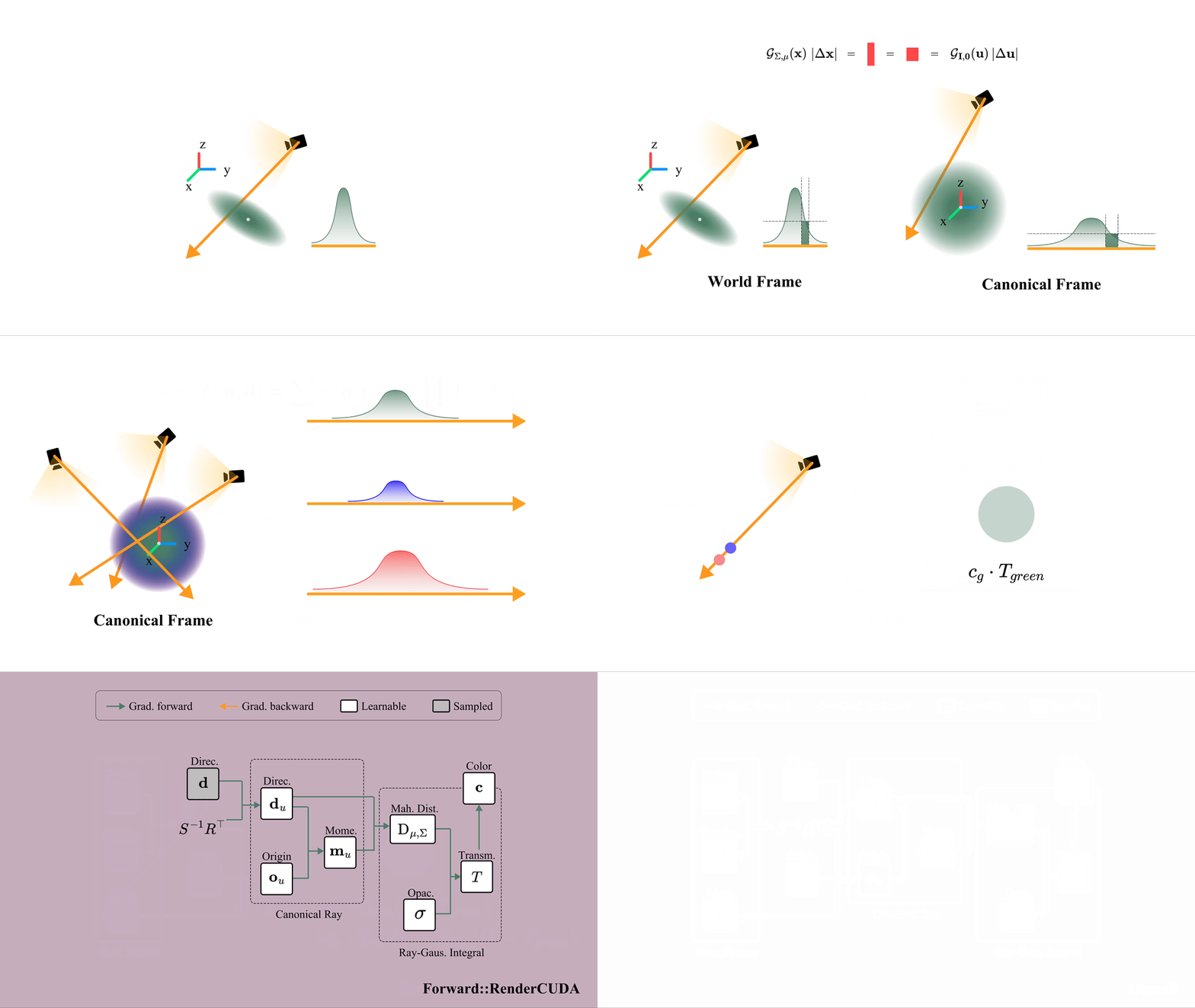
Ray–Gaussian Integral
We derive a projective-exact ray–Gaussian integral, removing the local affine approximation even under extreme wide-FoV settings.
Particle Bounding Frustum (PBF) Association
An exact and efficient ray–particle association scheme that enables high-speed rendering while eliminating grid-line artifacts.
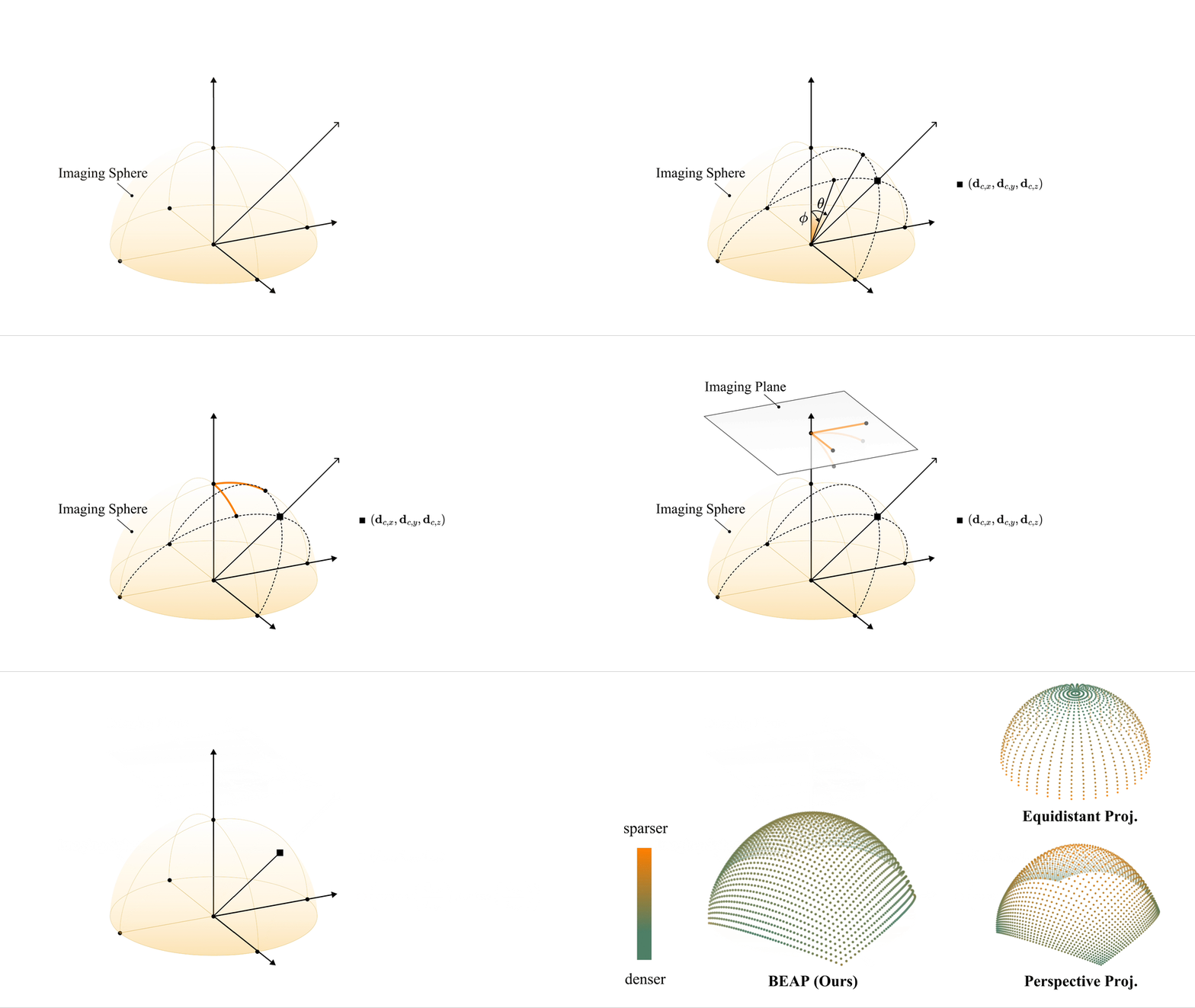
Bipolar Equiangular Projection
A unified angular-space ray sampling strategy that supports arbitrary FoV supervision.
Citation
If you want to cite our work, please use:
                    @misc{3dgeer,
                        title={3DGEER: 3D Gaussian Rendering Made Exact and Efficient for Generic Cameras},
                        author={Zixun Huang and Cho-Ying Wu and Yuliang Guo and Xinyu Huang and Liu Ren},
                        year={2025},
                        eprint={2505.24053},
                        archivePrefix={arXiv},
                        primaryClass={cs.GR},
                        url={https://arxiv.org/abs/2505.24053},
                  }
Special gsplat-geer Extension OSS Acknowledgements
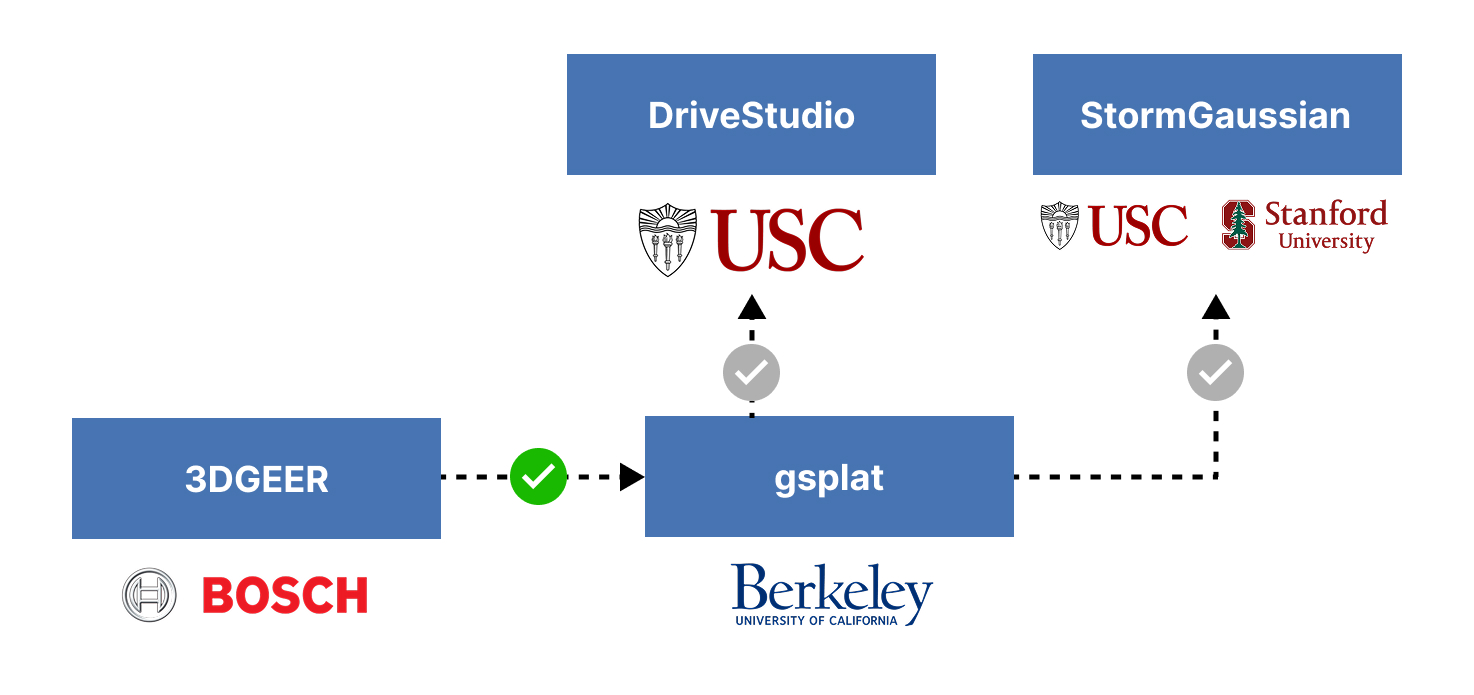 3DGEER supports the opensource community with
 gsplat integration.
Check out our gsplat-geer branch for details.
Core Contributors:
Edward Lee1,2* (GEER Public Integration),
Zixun Huang1,‡ (GEER Algorithm Derivation / Implementation),
Cho-Ying Wu1 (GEER Implementation)
Senior Mgmt:
Wenbin He1, Xinyu Huang1
Supervision:
Liu Ren1
Acknowledgements for additional contributions:
Hengyuan Zhang1 (Close-Up Parking Data Calibration)
Institution Acknowledgements


1 Bosch Center for AI, Bosch Research North America 2 Stanford University
The special extension work was performed when * worked as an intern at 1 under the mentorship of ‡.
Webpage Design Acknowledgements
The website template was borrowed from Michaël Gharbi and MipNeRF360.